To the Newly Diagnosed

IMG_7972

A couple people whose newborn babies were just diagnosed with Williams syndrome contacted me over the past few days. They found my blog and were comforted by the cute pictures and stories about Emmy, who has brought such incredible joy to our lives.

When you first find out that your newborn baby has any kind of syndrome, it can be a devastating time. You were expecting the experience that you so carefully planned out in your mind (What to Expect When You’re Expecting, anyone?? That book certainly doesn’t talk about Williams syndrome!). And then you find out that the little person you just gave birth to had a secret when he/she was in your belly–and you had no idea. You Google the syndrome and find information that frightens you. There may be serious medical complications, and there will surely be learning disabilities. How could this little baby that you don’t even know yet come with a laundry list of possible problems? It’s the biggest shock of your life, and you’re not even sure where to begin.

And here is where the wedge comes in. A barrier sinks down in between you and your baby, and it’s completely out of your control. You want so badly to lift that barrier. You want to stop the rush of feelings that come at you every day (sadness, guilt, anger, confusion). You want SO BADLY to accept this baby. You want to just “get over” what you’re feeling. What can’t I stop thinking about this syndrome? And then you wonder…When will it get better? When will I stop feeling like an awful person and begin to embrace this diagnosis and accept my own child?

I think we’re expecting a lot from ourselves. We had a certain vision in our mind. That vision was completely turned upside down, and we expect ourselves to just “get over it.” There’s actually a grieving process that needs to happen. You need to grieve the loss of your original vision–the perfect plan that you had in your head. You need to allow yourself to feel every single feeling that comes your way–without passing judgment on yourself.

And then, with time, that barrier will start to lift. You feel yourself getting drawn into your child. You stop thinking about Williams syndrome as much. You start to really fall in love with who your child is becoming. Those old visions that you once had are now replaced by new visions and plans. You get excited at your child’s potential. You see your child blossom into a sweet, loving person, and you can’t believe your luck. You were given this incredible child. You were given this opportunity to stand side-by-side with your child and watch him or her do amazing things. You were brought into a special world that not everyone gets to see.

For me, it was Emmy’s personality that changed everything. Early on, I read that people with Williams syndrome have “a very endearing personality.” They have big smiles and are overly friendly. I clung to those words as if they were my life raft. Everything else I read seemed scary. But “endearing personality” and “friendly” were music to my ears. Please let this be true, I thought.

And then Emmy cried and screamed for 6 long months, and I thought “Well, I guess this isn’t going to be true in our case! There goes that life raft!”

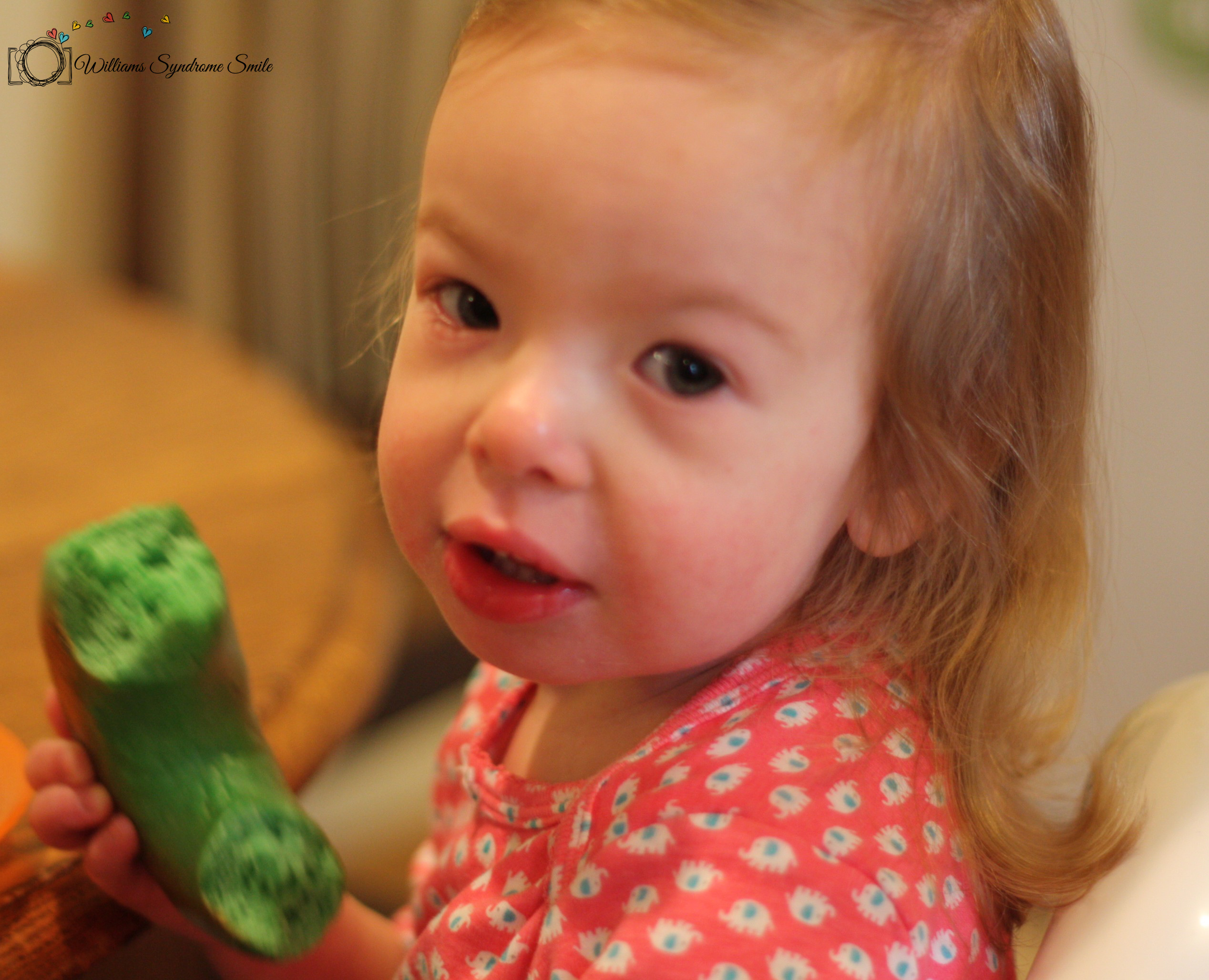
And then came the big smile that turned my world upside down. HOW I LOVE THAT SMILE!!! That was a Williams syndrome smile, and it was big and beautiful and bright. It was a glimpse into her personality.

The next thing to emerge was the friendliness. We’d be sitting at a restaurant chatting away, and then someone at a nearby table would squeal with delight. I’d look over, and a woman would be waving to Emmy and saying to a friend, “She’s so cute!!” I’d look at Emmy, who was happily waving back and grinning.

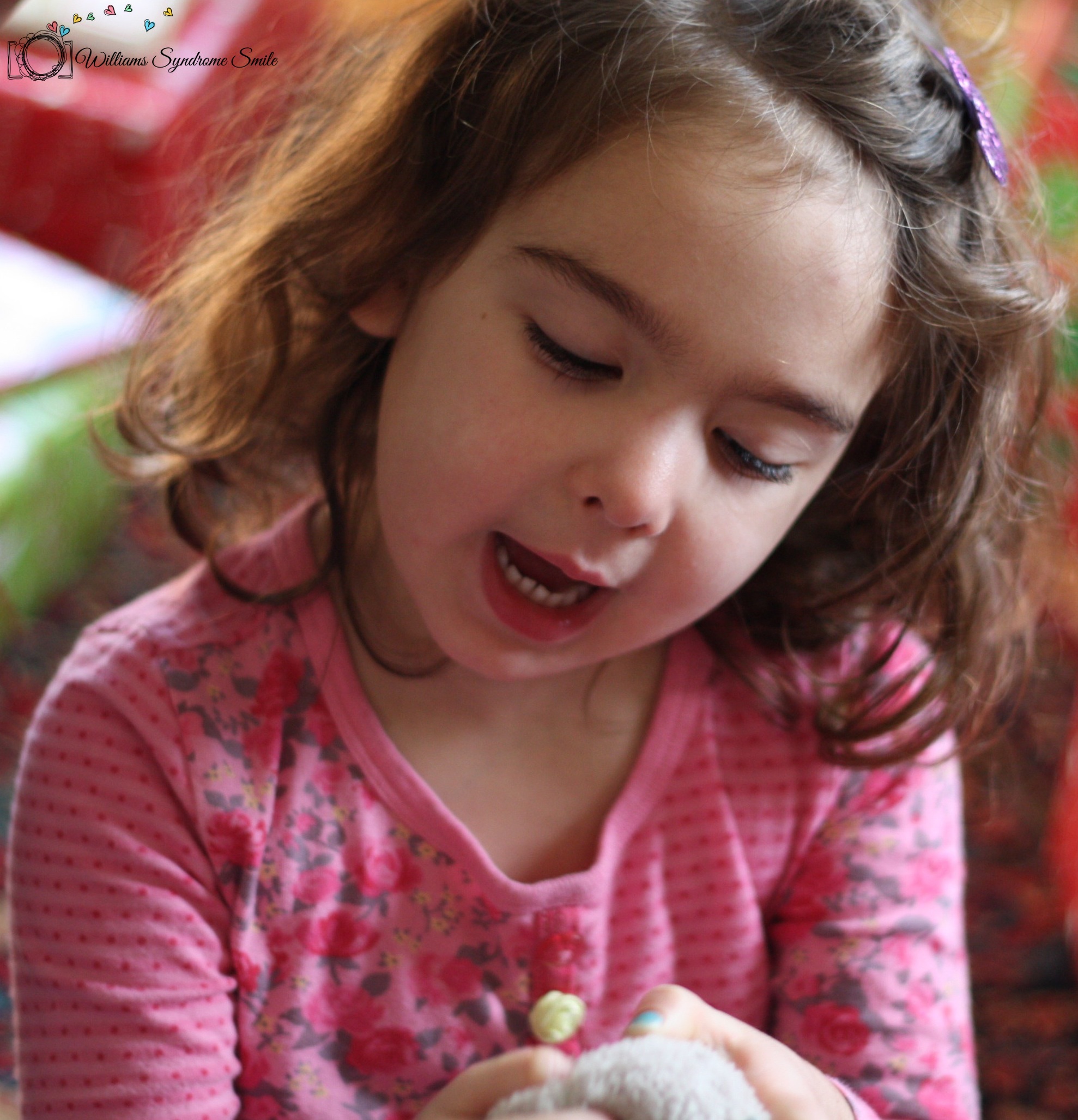
The thing is that she knows she’s cute. She knows exactly how to draw you in. First it’s the smile, then it’s the narrowing of her eyes and the tilt of her head, and now it’s followed by a phrase. She might say, “Hi. How you doing?” or she’ll call out, “Hi, kids!” or she’ll even blow you a kiss. I mean, she KNOWS what she’s doing, folks. She KNOWS that smile is pure gold.

The other day we had an evaluation at a school with teachers that are unfamiliar to her. In no time, she was putting on a show of “Twinkle Twinkle Little Star,” complete with smiles and hand movements. Anyone watching can’t help but say, “AWWWWW!”

She’s also very funny. If you ask her an obvious question (like “Is that a shoe?”), she’ll give you an exaggerated but joking “Noooooooo.” And then when you respond, “No? Are you sure??” She’ll say “Nooooooo” again, just to get you to laugh. She knows it’s a shoe, but she’s pulling your leg.

And she loves to chase her sister around the house while saying nonsense words like “Beebee beebee beebee.” Charlotte will run away from her laughing until, finally, both girls collapse in a giggling heap on the floor. It’s so much fun to watch.

So to the newly diagnosed I say: Wait.

It will take time to get to this point. And, in my experience, the first year is the hardest. So let yourself feel all of those feelings. Don’t pass judgement on yourself. Just really feel it. Get mad. Scream. Be upset. Say, “It isn’t fair!!”

And then, as the days, weeks, and months pass, things will change within you. You will connect with your child. You will fall in love with your child. You’ll be bragging about how wonderful he is. You’ll be glowing, fresh from the thrill of something new that she has done. And, even though you didn’t sign up to travel this road, it will feel as if this was meant to be–all along.

Inseparable

IMG_7436

These two have become inseparable, and that makes me so happy.

The backstory here is that, during my pregnancy with Emmy, I constantly fantasized about the relationship between my daughters. My sister and I are very close, and I could only imagine how strong the bond would be between Charlotte and Emmy. I imagined them just like my sister and me–sharing secrets and giving advice.

My weaknesses are my sister’s strengths. She’s six years younger than I am, but she’s often stepped into the big sister role on my behalf. I used to be painfully shy, and I would be terrified to return anything to a store. When I was fourteen and she was eight, my little sister marched into a music store on my behalf, walked right up to the register, and said, “Hi. I need to return this CD please.” I cowered towards the entrance of the store and peered around the aisles to see how the return was going. She came back triumphant with the money in her hand. I was always amazed at how easy she made it look. In a way, it was embarrassing to rely on my little sister. But I was also glad that I had someone in my life who would stand by me–no matter what.

Now that I’m older (and maybe a little wiser), I feel like I can pay it back. I’m usually able to give her a glimpse of life experiences before she goes down any road. I dated a couple of guys who were really (how can I put this nicely…?) awful. I like to think that she learned from my heartache and, sure enough, she was able to escape all the bad boys and ended up with an amazing boyfriend, who later became her husband. I’ve also been able to give her advice about her career or her life’s purpose. And, even though I’m the big sister, she still gives me tons of advice too. She’s mature–that kid. (She’s almost 30, by the way…)

I feel as though we have an equal give and take, and I value that so much.

And I saw the same for Charlotte and Emmy.

Then we found out about Williams syndrome, and all my visions of replicating the bond that my sister and I have went right down the drain. I just didn’t know anything about Williams syndrome. I didn’t know how Emmy would act or talk or think. It was an enigma. Would she be able to offer her strengths for Charlotte’s weaknesses, as my sister has done for me? Would she be able to give career advice? Would she know how to keep secrets? Would she even want to keep secrets? And how would Charlotte feel towards her little sister?

Early on, I started looking for stories about people who have siblings with special needs. I did find some very sweet stories. But I also found other stories–ones about feeling ignored by parents or resentful and angry. I found one story that really shook me. It was about a boy who was so embarrassed by his sibling with special needs that, instead of standing up for him, he joined the bullies in their taunting. Every day after school, a few bullies and his own brother made fun of this little boy as he walked home. GOOD GRIEF!!! That was hard for me to digest. If your sibling won’t stick up for you, who will?

All of this has been swirling around in my mind since Emmy was born. I’ve talked to my own sister about it several times. On the day we found out Emmy’s diagnosis, I remember sitting on the phone with my sister, crying, and asking, “But do you think they’ll be like us? What if Charlotte needs advice about her job? Will Emmy be able to give it to her?”

And my sister said the most wonderful thing: “Maybe Emmy will able to give the best advice of all. You just have no idea how she’ll see things. Maybe her way of seeing things will be so different from everyone else’s that her advice will be the most helpful.”

That positive spin really, really helped me.

And as the years have passed, this younger-version sisterly bond has grown very tight. When Emmy was a baby, she and Charlotte had the typical baby-toddler relationship. Sure, Emmy was cute, but she wasn’t able to communicate yet and cried…a lot.

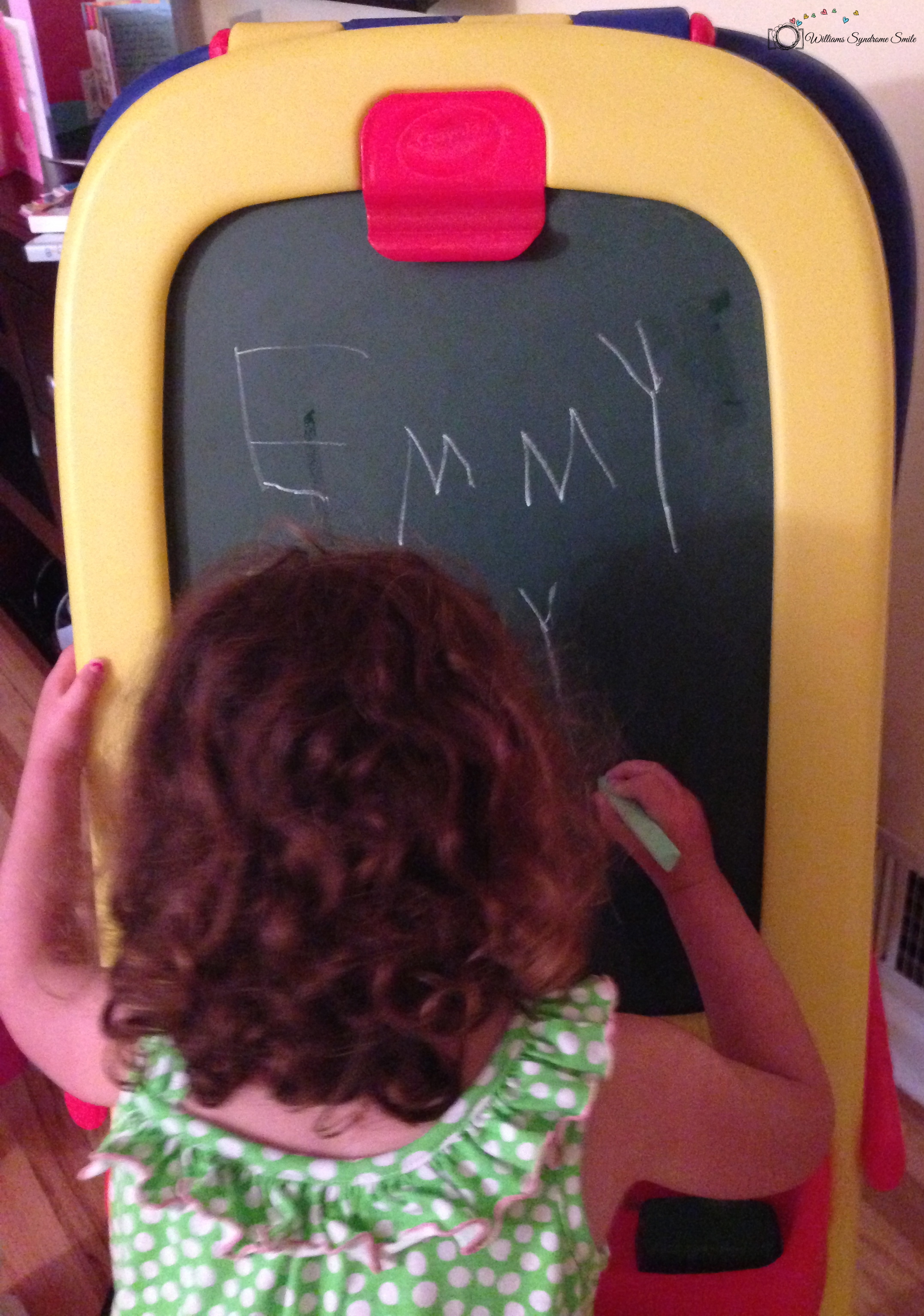
The first glimpse of their close bond came when Emmy was in the hospital for heart surgery about a year ago. Every day, for twenty-two days, Charlotte would bring home a drawing from school that said “Emmy” all over it. If you gave her a crayon, she would just write “Emmy Emmy Emmy” over and over. She got a chalkboard for her birthday last year and, sure enough, the first words she wrote were “Emmy Emmy Emmy.” To this day, almost every time she makes a piece of art, she writes “Emmy” at the top. She doesn’t write “Charlotte.” She writes “Emmy.”

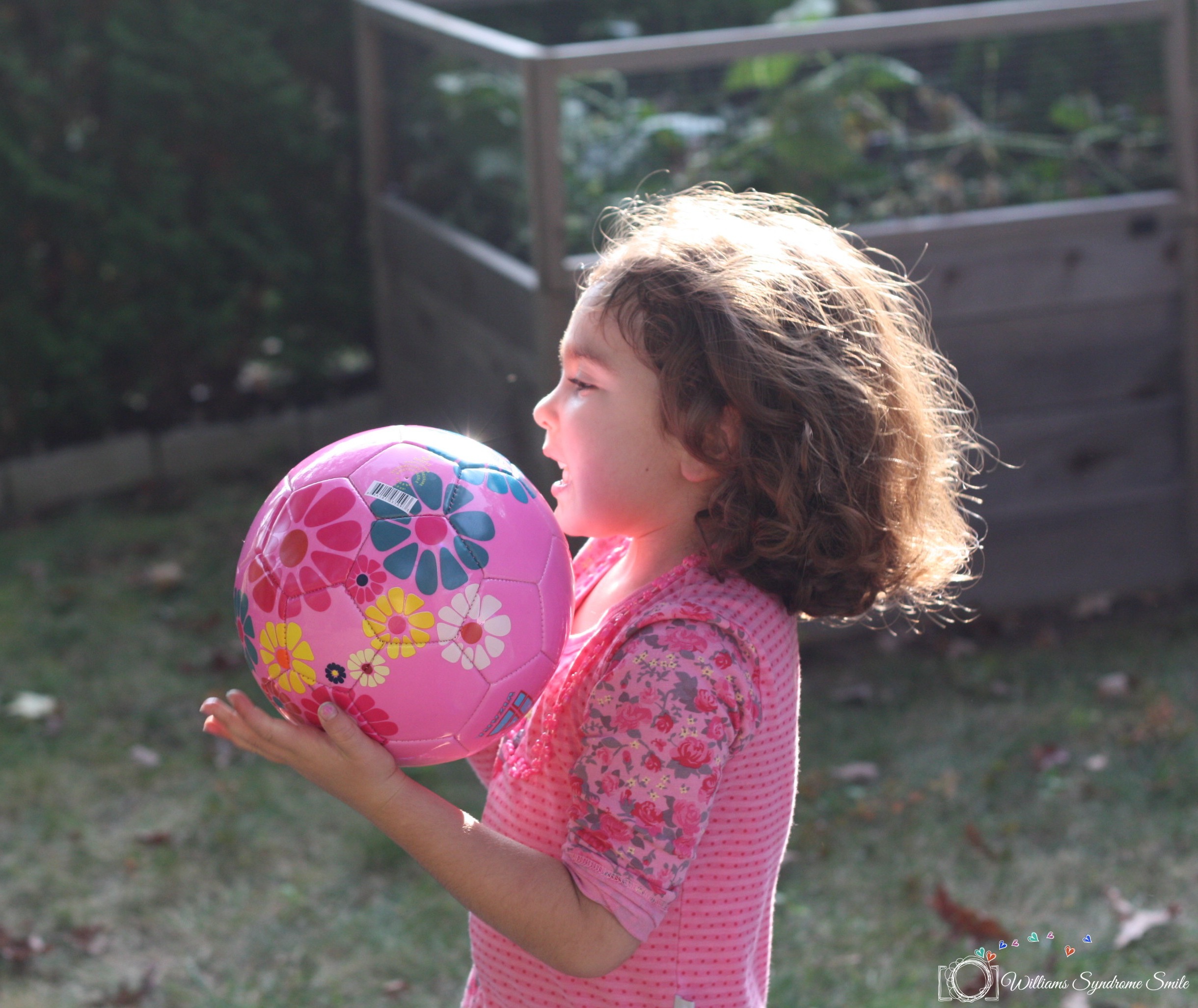
And now, as Emmy has become more verbal, they really have fun together. They playfully tease each other with high-pitched voices, they laugh and roll on the floor, they tickle, they share toys, they draw together; they hold hands.

Charlotte loves to be the teacher. “Emmy, look how I brush my teeth. See that? Now, you try it.”

And Charlotte is such a good cheerleader too. “MOMMY! DADDY! You won’t believe what Emmy just did!!” She’s so proud when Emmy hits little milestones, and she really notices those milestones, just as we do.

At almost five years old, Charlotte has started to develop fears (monsters, darkness, bugs). And wouldn’t you know that two-year-old Emmy has become her protector? If Charlotte is afraid to go to sleep at night, I say, “Don’t worry. Emmy is right here. She can protect you from anything.” And that seems to work!

On her end, Emmy just adores her big sister. We were at the hospital the other day, and someone who works there was named Charlotte. Well, every time Emmy heard “Charlotte,” she looked around frantically and asked for her sister.

Also, Emmy is eager to show her big sister any new thing. If she puts on funny sunglasses or finds a sticker or opens a book, the first person she wants to show is Charlotte.

At the dinner table, Dan and I just watch the two of them banter and giggle. There isn’t much eating going on (Charlotte is repulsed by my food most of the time…), but there is a lot of laughter. It will be interesting to see how their dynamic evolves when a little boy arrives in June. Right now, I am so happy with how close they’ve become. It’s better than I even imagined.

IMG_2867

Blogiversary

Blogiversary1

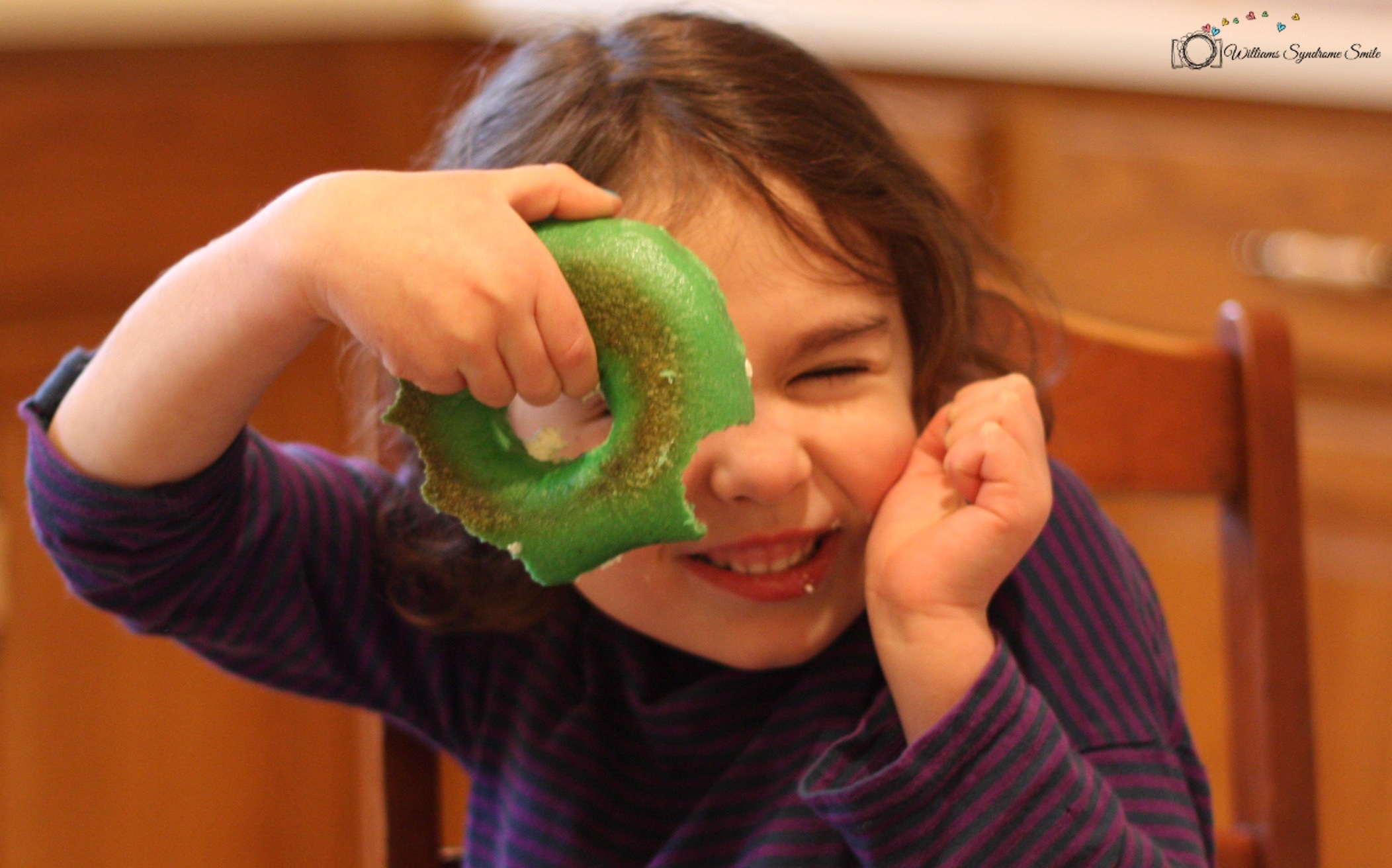
Somehow it’s the 1 year anniversary of my blog…which basically means that TIME FLIES! My first post was about green bagels on St. Paddy’s Day  (Green Bagel Morning), which we dutifully ate again this year.

Blogiversary2

I’ve really enjoyed blogging over the past year. I’ve loved the connections that I’ve made with people, and this blog REALLY REALLY helped me out when Emmy went into cardiac arrest after heart surgery last May (You can do it, Emmy!!!). I never in a billion years thought that I would be blogging while my daughter was on life support. It seems almost trivial. Blogging while your kid is on life support?? What??  I’m not even that much of a social media person, so it doesn’t seem to fit my character.

But oh-my-gosh, did it help!!! The messages of encouragement kept me going. And the support was incredible. I felt as though we were lifted through that entire experience on the shoulders of others. I didn’t feel like I was going through it alone.

I still get rattled when I look back on my blog posts during that time. It can bring me right back to that hospital room in a split second. It’s surreal to be so far removed from that experience now–physically removed but not mentally… Never mentally.

I have two favorite posts from the past year. I mulled over These Are The Shoes for a LONG time before I wrote it. Every time I opened Emmy’s drawer, those shoes would stare at me. And every time I thought, “I have to write about this feeling to get it out of me.” I’ve mentioned a few times that writing is like therapy for me. When something eats away at me, it’s all I can think about. And then once I get it down on paper, the immediate relief is unbelievable. Seeing those shoes every day really affected me and then, once I wrote about it, I was able to let it go. Amazingly, the shoes don’t bother me anymore.

My other favorite post is In Love. I LOVE that picture of Emmy. She looks like she’s shining from the inside out. That post represents a divide for me. I felt as though I let Williams syndrome come between Emmy and me for a long time. I was very aware of the fact that she has Williams syndrome. I thought about the implications a lot, and it kept me at a distance from her. This was totally unconscious on my part, but it happened nonetheless. We went through hell during her heart surgery and recovery and, while I would never want to go through something like that ever again, it helped me realize that Emmy is my daughter first and foremost. I no longer saw her as “my daughter, but let’s not forget that she has Williams syndrome.” I saw her as my daughter. Period. End of story.

And even though this blog is called Williams Syndrome Smile, my older daughter Charlotte, and husband Dan, (and the new baby soon!) have all played a significant role as well. I think this is more about life in general. Parenting is a minefield, I tell you. Having a child with special needs might color some of my experiences in a different way, but 99% of the time, I’m doing the normal things that every parent does. My #1 goal in life is to not screw up my kids…and yet I can guarantee that I’m already doing something wrong. (And it’s probably the thing that I think I’m actually doing right!! That’s the irony of it all.)

Thank you so much for reading and sharing, everyone!! I’m looking forward to Year #2.

Blogiversary3

Party of Five

PartyofFive

We’re going to have a Party of Five in June! I’m excited, nervous, happy, and hungry.

I’m trying to be calm and zen during this pregnancy, and I feel like I’m doing a pretty good job so far. My pregnancies with both Charlotte and Emmy were roller coaster rides, so I’m doing my darnedest to take everything down a notch this time.

You know how, when you’re young, pregnancy seems like the easiest thing in the world? Here’s how I imagined it at first: You get pregnant. You glow. You eat a lot. You pat your growing belly and smile. You decorate the nursery. You go into labor. You deal with some pain at this point, but you’re immediately given your beautiful baby as a reward. And your life becomes perfect.

(I thought that not only was pregnancy easy, but that parenting was easy too. HAHAHA. I guess I’m an idealist…or naive. Probably naive.)

But, as life has gone along, I’ve seen all different sides of pregnancy. There are the glowingly perfect pregnancies, and I am thrilled for them…while also being slightly jealous. It sounds like most celebrities have perfect pregnancies, but maybe they’re only giving us one side to the story. I’ve also become very close with people who have tragically lost babies, who have had trouble getting pregnant, who have had very challenging pregnancies, and who have found out that their babies needed to have surgery right after mom gave birth.

I also have a very cool friend who delivered her baby BY HERSELF IN HER LIVINGROOM because the baby arrived so quickly. My friend wrapped her baby in her jeans and waited for the ambulance to arrive. This happened in 2012, not in 1970 or something. I will forever be impressed by this woman.

I didn’t expect any of these stories, though. I had one vision of pregnancy, and I thought everyone fell into that category–except maybe .1% of people.

I think it’s important to be sensitive to other people’s stories. I’ve learned this both in pregnancy and in having a daughter with special needs. I’m really drawn to people who are humble. It means a lot to me when someone says, “I haven’t experienced what you’ve gone through…but I get it.” If I had a magic wand, I would get rid of all the gloating in the world. I don’t think it gets us anywhere. I met a mom at a playground once who was trying to one-up me on all the things Charlotte wasn’t doing but that her daughter was doing. Yikes, does that rub me the wrong way! It’s not about putting your story in a better light. It’s about understanding that all of our stories are unique and important. We can learn a lot from others, and I feel so much love for the people in my life who have gone through so much.

So here’s my story: I found out that I had a bicornuate (“heart-shaped”) uterus shortly before I got pregnant with Charlotte in 2008. This sounded like the worst news ever, and I was beyond devastated. I’ve come to find out that it’s not as awful as it sounds. My uterus didn’t form completely when I was born, which is really bizarre because that means I have a birth defect that I didn’t even know about until I set out to have kids! My uterus stopped short of the upside down triangle and, instead, formed into a heart. I know the heart sounds lovely, and so many of my friends tried to put a positive spin on it. But I was REALLY mad at my uterus for a while. I felt like it deceived me.

Of course, I immediately Googled “bicornuate uterus” and devoured all the horror stories. (I’m good at that. I tend to skim over the good stories to get to the real doozies.) The biggest problem is that I could go into pre-term labor.

So for my entire pregnancy with Charlotte, I was a mess. I let my mind go to all the bad places it could go, and I white-knucked the entire pregnancy. Because of the bicornuate uterus, I’m considered “high risk” so I also had a lot of doctors’ appointments and ultrasounds, which just made me more nervous.

You get the picture. I suffered mentally for 9 months. PHYSICALLY, I was doing pretty well! I had some minor issues that had nothing to do with my bicornuate uterus and were all resolved (like the time I fell flat on my stomach at 9 months pregnant…). But I wasn’t listening to my body. My body was doing great, and my mind was a mess. The two things were completely out of sync. It’s funny how my mind can take a life all on its own with zero regard to what is ACTUALLY going on with my body.

All the bad things I had read about through my endless Google searches never happened. Charlotte was born via C-section at 39 weeks, and she was happy as a clam! Such a good baby.

Ok, so you would think that my lesson would be: Don’t let your mind run away without you. Listen to your body. Do things differently next time. CALM DOWN.

Here we go again. I got pregnant with Emmy in 2010, and I started to follow my own advice. Caaaaaalm down. Don’t worry. Everything is going to be fiiiiiine.

I was doing awesome until 7 weeks along, when I had heavy bleeding–the likes of which you would not believe. My mind immediately went back to panic mode. We had an ultrasound that showed Emmy was fine, but I was a nervous wreck for the rest of the pregnancy. I couldn’t get back to that zen place again. Also, Emmy was always measuring small. We’ve come to find out that this is pretty common for Williams syndrome, but we had no idea that she had Williams syndrome until 5 weeks after she was born. So the fact that she kept measuring small seemed odd to me and, again, made me nervous. I was still considered high risk and had all the doctors’ appointments and ultrasounds that you can imagine, which heightened my nerves even more.

But, again, for the majority of my pregnancy, I was fine physically. It was the mental aspect that took a toll on me–again! Even though I swore it wouldn’t.

Emmy was born via C-section at 39 weeks. She had a lot of problems right out of the gate and had to go to the NICU–and then of course we got the diagnosis of Williams syndrome a few weeks later. But we didn’t know about any of this during pregnancy, and I could’ve saved myself a lot of stress while I was pregnant if I just focused on how my body was feeling instead of paying attention to my over-active, always-working mind.

So here we are with Baby #3–a boy! And I have a whole HOST of problems. But I think I have finally learned my lesson. I refuse to let my mind get away from me this time.

The first problem is that I have a thin window on my uterus. Basically, this means that part of my uterus has been deemed “paper thin” and, if I were to go into labor, my uterus could rupture. My second problem is that, because of our history with Emmy, we have to do more in-depth ultrasounds to make sure that there are no heart issues. No one thinks this baby has Williams syndrome (though it would be pretty amazing, considering it’s a 1 in 10,000 completely random event). We’re no more likely to have another baby with WS than any couple would be to have a first baby with WS. But when one of your babies has a genetic issue, they do want to look closely to make there there is nothing else that we need to be aware of. (For instance, if the baby had a Congenital Heart Defect, which is a 1 in 100 statistic, we would have to schedule surgery for after the birth etc.) My third problem is that I’m technically still at risk for pre-term labor because of my bicornuate uterus, so I have to get checked more often than your average patient. And, fourth, this baby has a kidney issue, which is apparently common in boys and nothing to worry about–unless it’s something to worry about…and we won’t know that until we get further along.

Given my history, you’d think I would be freaking out, particularly about the kidney issue. But here’s what I’m doing this time. I’m staying grounded. I’m NOT Googling. I absolutely refuse to Google. I won’t go searching for all the horror stories like in the past.

Sure, I have my moments of worry and panic, but I’m able to bring myself back down again.

How am I getting there? Well, I’m listening to my body. I feel…fat. 🙂 But good and happy and comfortable and calm. I’m looking forward to spring. I’m thinking of all the things I want to do with my girls to enjoy the last memories of the Party of Four. I love seeing Charlotte and Emmy together. Their sisterly bond has gotten so much tighter. It makes me SO happy.

I want to capture this moment of zen and carry it through to the delivery in June. I want to trust my body, which has proven itself before. I want my body and my mind to be in sync throughout this pregnancy. I want to enjoy and remember many moments throughout this pregnancy. And, this time, I want to savor that pregnancy glow.

What About Me

WhatAboutMe

I’ve been waiting for this day. Although I certainly haven’t been looking forward to it.

We got our first “What about me?” And it made me feel AWFUL!

Ever since we found out that Emmy has Williams syndrome, I was conscious of how it would impact Charlotte. In the beginning, Charlotte had no idea that there was anything different about Emmy. But, as time has gone by, we’ve had conversations about heart surgery and Williams syndrome and how things are more challenging for Emmy.

Charlotte clearly doesn’t notice any differences yet with Emmy. She’s just her sister. Period — end of story. But now she’s started to take notice of all the special treatment Emmy gets. The additional doctors’ visits, the therapy sessions at school; the meetings with therapists at home.

One wouldn’t think that she would be envious of doctors’ visits, but she is! Charlotte actually loves going to the doctor and dentist. (I’m sure Emmy would gladly trade places in that respect because all hell breaks loose when Emmy senses that she’s going to get poked and prodded by someone.)

And Charlotte is envious of the therapy sessions because they look like fun! Emmy is spending time with really nice therapists who play games with her and cheer her on. What’s not to like?

Well, all the special treatment has started to add up, and it came to a head yesterday when we had an Early Intervention meeting with Emmy’s team of therapists to discuss her goals. Charlotte was supposed to be at school, but it was cancelled. So she got to watch everyone fuss over Emmy some more…and it wasn’t fun for her. She wanted to be fussed over. And in her effort to get attention, she jumped on the couch and tried to get somebody — anybody — to focus on her. Of course, this resulted in a lot of wild bouncing around, and it was hard for me to try and hear what the therapists were saying. It was difficult to manage the situation, but I tried not to get frustrated with her. I know what she wants because I would’ve wanted the exact same thing when I was her age.

The thing is that I’ve been trying so hard to over-compensate for Emmy’s special attention. I wanted to head this off before it started. I didn’t want Charlotte to ever feel ignored. So my husband and I both take her for one-on-one time every weekend. We also signed her up for soccer, gymnastics, and swimming, and we try and make a big deal over all her various activities. My husband even coached the soccer team! I take her for mani/pedis. I read to her. I snuggle with her. I do arts and crafts with her — just the two of us! I try everything in my power to make her feel like she’s special too!

But yesterday when all the therapists left, her face fell, and she said, “What about me?”

She wanted to know, “Why doesn’t anyone get together to talk about me?”

And she’s right. All the outside activities that I do with her don’t compare to the fact that a bunch of people sit in a room and talk about Emmy for an hour. How can I possibly recreate that situation for Charlotte? I don’t know…

I told her that I talk about her and how awesome she’s doing with her teachers all the time, but that’s not the same…

The thing about Charlotte is that we don’t have to sit in a room and talk about how to get her to open a Ziploc bag, or climb the stairs, or keep her balance. She does all of those things beautifully. They’ve never been a struggle for her. Every single goal we set for Emmy yesterday are things that Charlotte has already met. And they all came easily to her. I don’t think I ever had to teach her how to use a fork and spoon. She just did it.

And I’m so conscious of the fact that she is very sharp. This morning, Charlotte was playing with her dolls, and I heard her doing math very quickly! She was saying, “What’s five plus three? Eight! What’s two plus seven? Nine!” I mean, she was QUICK. I was really impressed. And I told her so right away! She’s also really good at gymnastics — very strong and fearless. I watch every gymnastics’ practice. I take videos of her hanging on the uneven bars and send them around to family members. I celebrate her artistic talent and hang up her paintings.

But kudos from mom doesn’t compare to a bunch of people sitting in a room and reviewing her accomplishments for an hour.

So with all of my attention and praise, I don’t know how to recreate that aspect — that type of special treatment that doesn’t apply to typical children. The therapy sessions, the doctors’ visits, and the goal-based meetings. How does an arts and crafts session with mom compare to those things?

If anyone has suggestions, I am all ears! Maybe I can have relatives dress up as strangers and come over to discuss Charlotte’s progress. 😉 I’m picturing my mom with a funny hat on and a feathered mask over her eyes…yikes!

Or maybe the answer is just to keep stressing that things are harder for Emmy and, while these therapy sessions seem like special treatment, Emmy would rather not have to work harder than everyone else. That’s not an easy concept for a 4 year old to understand though. Especially because she notices how Emmy loves getting doted on by her therapists. It certainly doesn’t look like hard work to Charlotte!

I just want to do it right. Like every other mother out there, I have guilt up the wazoo — both for things that have and haven’t happened yet! (I love that I already have guilt for things that haven’t happened yet, by the way. So silly yet so true.) I want to get on the right path, but sometimes I don’t even know where to start.

Something to Watch this Weekend

Screen Shot 2014-01-31 at 1.36.31 PM

Photo credit: http://www.missyoucandoit.com

If you have HBO On Demand, do yourself a favor and watch a documentary that will capture your attention and melt your heart. If you click on HBO and go to “Documentaries” then “Feature Films,” you’ll find a movie called Miss You Can Do It.

You can watch the trailer here: Miss You Can Do It Trailer

I’m not usually into movies about pageants, and when my husband and I sat down to watch it, I thought, “I hope this isn’t too pageant-y…or too depressing…” Usually, when we do video date night (because you know we’re not going out to the movies), I try and find something funny and light-hearted.

So, for this one, I took a chance. And, yes, I bawled my eyes out–but in a good way! I highly recommend it, for parents of typical children and those with special needs.

I wish that I had been more interested in special needs before I had a child with special needs. Does that sound strange? I feel like I was incredibly closed off from that world, and now I realize that I could’ve gotten involved a long time ago.

If my daughter didn’t have special needs, would I have watched that awesome pageant documentary?

Or this one? Monica and David

Or this one? Best Kept Secret

I can tell you the answer. I probably wouldn’t have watched any of them. I don’t think that makes me a bad person. I think we’re drawn to what we know. And I didn’t know ANYTHING about special needs until July 2011, when Emmy was born.

I know that Oprah loves this quote by Maya Angelou: “When you know better, you do better.”

In my case, I think that it would be: When you know more, you do more.

I’ve stretched my boundaries because I had to. But I’m so glad that I had to because I never would’ve seen what was on the other side.

Over the past few years, I’ve met a fair amount of people who have dedicated themselves to special needs work without having a child, or sister, or brother with special needs. They just did. For various reasons, or perhaps for no reason at all, they wanted to help. I am always touched by those stories. I think I’ve asked almost all of our Early Intervention therapists, “So how did you get into this?” Where did that all start? One therapist told me that, as a teenager, she was helping a friend of the family with her autistic child. I can’t tell you how much that impacted me because I thought back to what I was doing as a teenager and, while I was a good girl :), I wasn’t involved in anything meaningful on that level. I didn’t stretch much out of my comfort zone. One of my goals is to open my children up to a world beyond what they can see. There are many people out there, each with his/her own story to tell. It makes me feel good to finally open my eyes to all of those stories, not just my own.

Why I Stopped Apologizing for My Child

Apologizing

A while back, I was looking to find a daycare that Emmy could attend a couple days a week. Before I started my journey as a mom, I assumed that my kids wouldn’t go to daycare because I had images of constantly-runny noses, unchanged diapers, and bored staff. Woah, was I wrong about that one! I’ve been able to find daycares that are run more like schools, so my kids are learning, having wonderful social interactions, and making cool art projects. They’ve also become very close with their teachers, and I love to see those special bonds forming. So I am pro-daycare, if you can find the right place.

This happened before I found the right place…

Emmy was too young to attend Charlotte’s daycare, which we’ve been very happy with, so I needed to find a place that would take younger children. And I needed to decide when I would drop the words “Williams syndrome.”

Here’s the thing. Not all parents reveal that their child has a diagnosis. They don’t want a label, they’re worried about their child getting into the school, the don’t want their child treated any differently, etc. I empathize with all of these concerns, and I’ve thought about the same things myself.

In my case, though, I knew I had to tell the school about Williams syndrome. First, I knew that our pediatrician would have to fill out a Universal Health Record before Emmy started school, and that it would say “congenital heart defect due to Williams syndrome.” So the cat would be out of the bag at some point. Second, I figured that the teachers would pick up on her delay and ask me about it. I didn’t want to have to fib my way out of that one. Third, my memory is not great. I would never have remembered who I told or who I didn’t. That’s part of the reason I don’t keep her diagnosis a secret from anyone. I would literally have to carry around a notebook and jot down who I told and who I didn’t — and hope that those people never run into each other!

Ok, so I knew I was going to tell. I just didn’t know when or how.

I called the first school and asked if they had room in their program for her age group. The Director said, “Yes. Come on over.”

I hopped in the car and mulled over how I would tell him about Emmy. When I arrived, he offered me a seat in front of his desk. All I could think was: Williams syndrome Williams syndrome Williams syndrome. He told me a little about the program. I nodded and smiled. Williams syndrome Williams syndrome Williams syndrome.

Finally, he stopped talking and asked me about Emmy. He wanted to know if she was either cruising or walking because that would determine her classroom. They had room in both. At this point, Emmy was barely cruising. She was holding onto furniture, but she wasn’t cruising with ease. I knew, though, that if I didn’t talk her up, he would put her in the infant class with the kids who weren’t walking at all. I didn’t think that holding her back, in that sense, was best for her development. She needed to learn from the kids who were already walking. She was also closer developmentally to her own age group than to an infant.

So I took a deep breath and confidently said, “Yes, she’s cruising. She’s been a little slower in that respect because she has Williams syndrome.”

Cat’s out of the bag!

I swear his eyes nearly popped out of his head.

“And what’s that?” he asked.

I told him about Williams syndrome and, in doing so, I realized that I was apologizing for my child. I was emphasizing that she was practically typical and that Williams syndrome was no big deal. Honestly, I felt gross. I was sugar-coating. I wasn’t being real, and I wasn’t being true to my child. When I saw the look of concern on his face, I just kept laying it on thick — how Williams syndrome would be no problem at all. I didn’t dare say that she might need help on the playground or with art projects. I didn’t mention how great it would be if her Early Intervention therapists could come and work with her. I acted as if she would be just fine with no help whatsoever. And then I sat back and waited for his response.

He looked incredibly uncomfortable. He didn’t embrace the situation. Instead, he probably heard nothing I said after the word syndrome. He nervously said, “Ok, let me go check back in with those numbers and make sure that we have room in the cruising class.”

He walked away and came back with a post-it note that had a number on it.

“Turns out we’re at our limit!” he proclaimed. “I thought we had room, but I was wrong. But I’ll certainly give you a call if anything opens up.”

I’m sure he was lying. On the phone, they had room. In person, after my revelation, they were suddenly booked.

I got back in the car, feeling sick, and drove to the next daycare. I debated not revealing her Williams syndrome this time, but I knew I had to for all the reasons I mentioned above.

This time, I toured the school first and then sat down with the Director who said they had one more slot. Great! She couldn’t back out on me now.

I then told her that Emmy has Williams syndrome and, to my horror, I fell back into that sickening apologetic tone. At one point I even said, “You wouldn’t even know there was anything wrong with her.”

UGH. OUCH. I couldn’t believe those words came out of my mouth.

The Director smiled sweetly and replied, “But there isn’t anything wrong with her.”

I felt awful. Here was a stranger who needed to tell me that there wasn’t anything wrong with my child. But talking to her made me feel like I was getting somewhere. I felt as though she understood and was ready to accept Emmy with open arms.

She then asked if Emmy had any medical issues. I said that she has a heart problem due to Williams syndrome but, here we go again, it’s no big deal.

Heart problem?? The air left the room. Her attitude of acceptance turned into a brick wall. This sounded like a liability.

“Welllll,” she started. “You know I’ll have to check with Human Resources about that.”

People have since told me that it’s illegal to not accept someone with a heart condition, but I haven’t done enough research to confirm that. All I know is that, when I called her later to see if she had checked with Human Resources, she said she was mistaken and that they actually didn’t have room for Emmy. The class was full.

So the woman who just told me that there was nothing wrong with my daughter was able to find something wrong. Thanks for the life lesson, lady.

I felt disgusted. I had basically sold my soul to explain away Williams syndrome, and both places rejected me. I felt as if I weren’t giving Emmy the credit she deserves. Instead of proudly embracing what was special about her, I was apologizing for her and explaining her differences away. And they didn’t take her anyway! All of my sugar-coating got me nowhere.

So I decided to speak honestly and openly about Williams syndrome. It is harder for her to do things. But, damn, does she try HARD at everything she does. She perseveres like no one else I’ve seen. And her sweet personality is just such a gift. I’m so proud of this girl.

Just as I resigned myself to not finding a place that would take her, there was a phone call from another school that we had been trying hard to get into. We had been on the waiting list for a while. They were packed but found a spot for Emmy a few days a week. The Director was so welcoming and, when I talked openly about Williams syndrome, I didn’t scare her away in the least. She said that she couldn’t wait to meet Emmy and that they were so happy to have her. I asked if we could have some of her Early Intervention therapists there to help her, and she responded, “Of course!” She didn’t freak out about Emmy’s heart or about her lack of walking. She wanted to put Emmy in with her age group, which I whole-heartedly agreed with. It felt good, finally, to be heard and understood.

Thinking back on my “apologies” for Emmy makes me feel icky to this day. Hey, this diagnosis isn’t her fault! She did absolutely nothing wrong. Through a completely random genetic event, she was made this way. And, boy, do I love everything about her.

So this whole experience, while stomach-churning in parts, gives me the confidence to say:

I am no longer apologizing for the special needs of my very special child. 

Love you, kiddo.

January

January1

I’m having an interesting time with January so far. I’ve been going nonstop from Halloween through the end of 2013 — holidays, snow days, presents, clutter cleaning, cards, lights, tree, the ambition to do “holiday related” activities; the ball drop at midnight. It was a big rush to New Years.

The self care that I’ve written about before got pushed way to the back burner. I just put my head down and GOT THINGS DONE. Writing is very therapeutic for me, but even that  went straight to the bottom of the list. I actually felt guilty glancing over at my stack of books about writing. I’ve been working on a memoir about the past two years and, if it gets finished before 2045, it will be a miracle.

So, with all the craziness of October-December, I slid into January needing a complete recharge. It was hard for me to get back into writing right off the bat, but I cleaned out the clutter in the study, which is always a precursor to SOMETHING happening. And then I sat down with a few writer friends last week and, wow, did that feel good. It’s funny how some of us completely ignored our writing during the holidays, while others were actually productive. The productivity of others helped ignite that fire within me again. The words of encouragement from friends “You have to finish this book” also moved me forward.

But there’s something else stopping me too. When I write about the past two years, I want so badly to capture how I initially felt about Emmy’s diagnosis, how that feeling sat with me for a good six months and was only chipped away at little by little, and how that feeling is so far from what I feel today. As I move away from that feeling, it’s harder for me to go back where. Was I really devastated by this diagnosis? Really?? It’s hard for me to believe looking at the sweet, funny, good-natured, lovely daughter that Emmy is today. When we sit down at the breakfast table every morning, she gives the biggest, brightest smile and announces what she’s eating. I’ve never seen anyone that happy in the morning–ever! “Yogurt!” she declares, holding it up for me to see. Was I really upset for 6 months about Williams syndrome? Really?? It’s hard for me to even believe it myself.

In order to write about it accurately, I have to go back there in my mind. I somehow have to put aside the smiling cutie pie that I see in front of me and sink back into that mindset. Because even though I’ve moved on from that early time and changed my views on Williams syndrome by 180 degrees, I still feel like the story is inside of me. It’s just sitting there, waiting to come out. It’s been sitting there for 2 years now. I’ve changed, but the story is still heavy on my mind.

It’s the story of how I thought I would never smile again. It’s the story of how I bought every book I could find about having a child with special needs and read them through tears thinking, Is this really happening to me? It’s the story of how I thought my marriage was going to crumble because that’s just what happens, right? And it’s the story about how it was so hard to connect with Emmy for 6 months because I felt as if she were underwater. There was a barrier between my daughter and me and, during one Early Intervention meeting, I broke down sobbing and said, “I feel like she’s underwater. I feel like there’s a veil there, and I can’t break through. I don’t know how to connect with my own daughter.”

Those feelings have completely dissipated now, and the child that was once “underwater” now runs into my arms and says “Huggie!” But that story is still sitting there, and I remember it well.

The thing about writing memoir, though, is that it can hurt to go back there. If I were writing fiction, I don’t think I’d end up in tears just thinking about Chapter 2. And because I don’t want to feel that hurt again, it keeps me from sitting down and writing. Though if I don’t write, I still always think about writing, and that just drive me nuts…

I haven’t written fiction in a long time. I also haven’t read fiction in a long time (except for my friends’ pieces), though I’m starting to get back into it now. Memoir and personal essays really speak to me. A couple years ago, I wrote a very painful, true piece for a writing group. It was difficult to write but, boy, did it feel good to get it out. At the end of the night, we were all filing out into the parking lot, and this woman held me back to say that my piece really touched her because it was so raw and it brought her right back to things she’d experienced as well. That’s when I’m writing at my best–when I can go to that place and not sugarcoat. To me, the words don’t matter as much as the feeling behind it. I can always go back and change the words. But I can only revisit those feelings so many times before I can’t go there anymore. Or, in Emmy’s case, before I become too far removed from those early months and completely forget the pain that I was in.

Emmy will be 3 in July. Can I finish this memoir before then? Before I completely and utterly forget what it was like when my daughter was “underwater”? One of my writing friends suggested keeping a daily word count. That way I won’t get bogged down in revising Chapter 1 (as I’ve already done 100 times…). I just need to keep moving forward–get the story off my chest. Get it DOWN on paper. And, no matter where it goes from there, I will have gotten it out of me. For me, that is therapy.

Tradition

Tradition

My husband is really into tradition. I mean, REALLY into tradition. Actually, the very first post I wrote was about how he buys green bagels every St. Patty’s Day: https://williamssyndromesmile.com/2013/03/17/green-bagel-morning/

He doesn’t just keep old traditions alive, though. He also spontaneously creates new ones! I was heading home with the kids when he called to say that he put the holiday lights on the house and wanted Charlotte and Emmy to turn them on when we arrived.

“It will be a tradition!” he declared.

I love that Dan doesn’t live by the same imaginary rule book that I have in my head. My rule book says that I preserve the traditions that were handed down to me, but I don’t create new ones. Who am I to create a tradition? Those things were carefully thought out by my ancestors! But Dan has no qualms about creating a tradition TODAY.

And I’m ashamed to say that I kind of brush them off (sorry, babe). Traditions are not as weighty for me. I have a few precious traditions surrounding Christmas that remind me of childhood but, other than those, I don’t really think about traditions for the rest of the year.

Over the weekend, I found myself really appreciating the fact that Dan keeps traditions alive when we got the tree and decorated it. And as the kids put ornaments on the tree, I was so aware of how this tradition forces you to be present. It forces you to put down the phone, look at every ornament, tell stories about the ornaments, find the perfect branch, take photos to capture the moment, admire how your daughter is so careful with the precious ornaments when just last year she would’ve been the opposite, notice how your daughter carefully stands on the stool to reach the top branches, and realize how much taller she is than the year before. When you’re decorating the tree, you are forced to be in the moment.

How many times do I swear I’ll appreciate every moment–and then still let all of them pass me by?

And how many times do I swear I will PUT DOWN MY PHONE…and then will see it calling to me from the table?

“Put it down, woman!” I want to shout. “Put it down!” Because when I’m looking at my phone, I am anywhere but in the moment.

I think it doesn’t matter so much when I’m in the check-out at the grocery store and the person in front of me has 1,000 bags of candy to ring up, and I am just passing the time by looking at my phone. I think it DOES matter a lot when my kids need my undivided attention.

On Saturday, I was at a kids’ gym with Emmy, waiting for her class to start. I was watching the previous class wrap-up through the large, glass windows. And here was a boy, probably less than 1 year old, throwing a ball to his dad. And here was his dad, looking at his phone. The ball just fell in his dad’s lap, and he didn’t even notice his son’s effort. Ugh. What are we becoming?

So if traditions, like decorating the tree, do nothing more than force me to put down the phone and be present, then I am incredibly grateful that my husband creates new traditions every week. The more, the merrier! This time with our kids is precious and fleeting. The celebrity gossip and articles with snarky comments that I read on my phone will be around forever.

Thanksgiving

Thanksgiving

This Thanksgiving has been my favorite so far, and the actual day isn’t even here yet! Just listening to Charlotte recite what she learned at preschool every day has been a lesson in life. At four years old, she’s full of amazement, wonder and fun facts (yesterday was something about white and red blood cells that even I didn’t understand).

I love watching her face as she laughs her way through “The Thanksgiving Song”: “I’m glad I’m not a turkey…They stuff you and bake you, and then they all taste you! I’m glad I’m not a turkey on Thanksgiving Day.”

And every day this week, when she’s climbed in the car after school, she starts excitedly talking about gratitude.

“Guess what I’m thankful for today?” The appreciation for life literally pours out of her.

As I was driving her home, I thought, “At what point does this change?”

Because I’ve certainly experienced it myself. As a child, I had that feeling of amazement and gratitude on a daily basis. I remember bouncing a tennis ball against the side of my garage for hours–just enjoying the sun and the feel of the ball in my hand. I was just happy to be alive. Of course, I wasn’t consciously thinking about being alive. But I was enjoying the moment–taking pleasure in the littlest of things.

And as I got older, that feeling began to seep away. First, there were some mean girls (ugh), and I allowed my spirit and sense-of-self to get crushed. Then there was the sinking feeling that came with getting C’s on Math tests. And then there was the pressures of bills and jobs and life. Sure enough, that incredible feeling of being in the sun with a tennis ball in my hand faded and, in its place, came thoughts of “Why me?” and “I can’t do this” and “Life is so hard.” I kept feeling as though life was just dropping things on my doorstep, and I had to deal with them.

I finally realized that it wasn’t healthy to live that way–to always feel as if life owed me something, and it was my fault for not getting the best out of it. My four year old doesn’t feel that life owes her anything. On the contrary, she enjoys all that life has given her, and she voices her gratitude aloud.

I don’t want that shift to happen for her. Is it inevitable? Gosh, I hope not. How can I help her stay grateful for what she has instead of always reaching for something more? Because that’s where true happiness lies–in looking at what’s around us and saying, “Thank you.”

Today I can make a choice. I can always reach for something more, different, or better…or I can land right where I am. So here’s where I am today: I’m in my soft, colorful pajamas on a Wednesday morning. I’m typing away in the study, listening to the soothing sound of rain on the window. My husband is in the kitchen making mac-and-cheese for the Thanksgiving party at school. My two-year-old is still fast asleep in her bed. And the sound of a happy four-year-old playing make believe floats through the air. Thank you, life.